Goldfish Care Basics: Temperature, Tank Size and How Many to Keep
Goldfish are not tropical fish: 20-25°C (68-77°F) suits them best. Tank size, stocking, filtration, water changes and feeding for beginners.
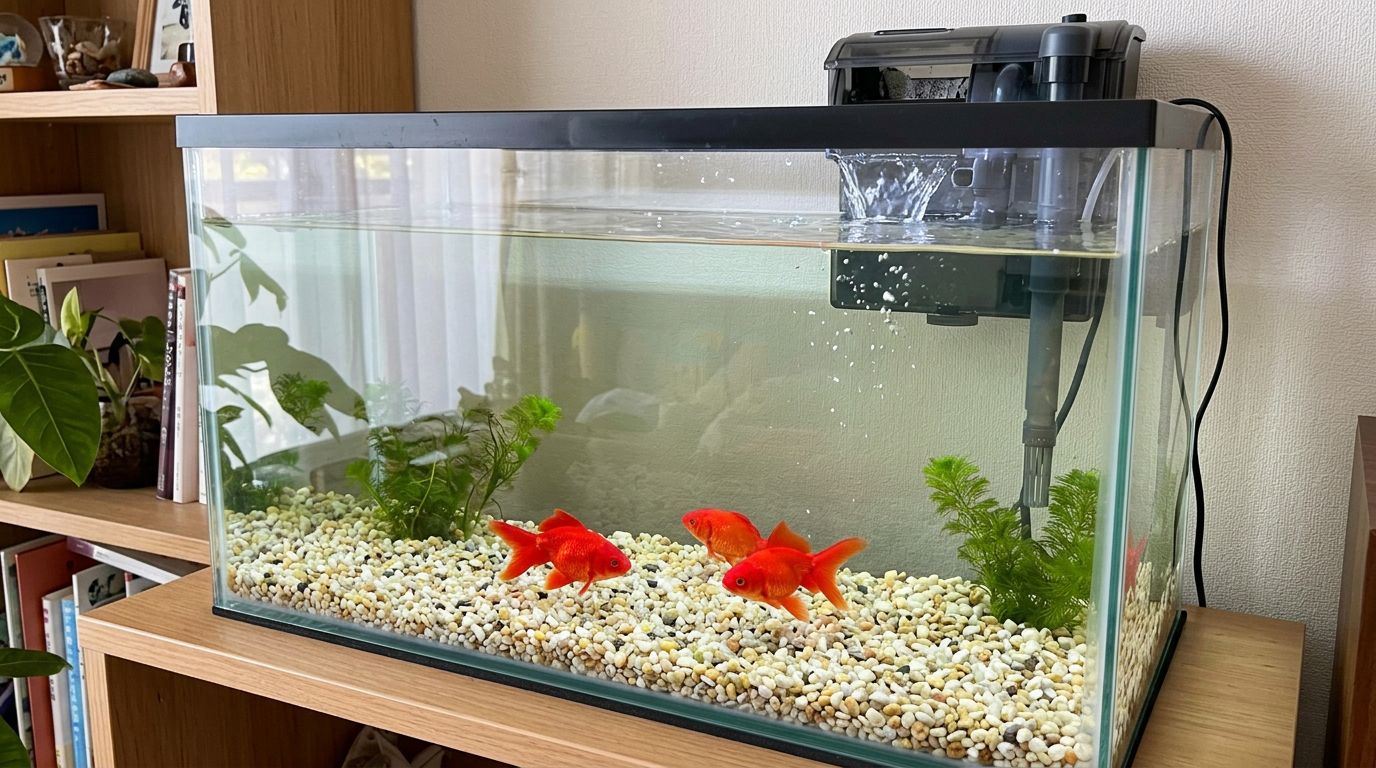
"Goldfish are tough, so a small bowl is fine." Plenty of people start there and find their fish struggling a few weeks later. Goldfish are hardy, but they also grow large, eat a lot and foul their water quickly. The short version: they are most comfortable at around 20-25°C (68-77°F) within a workable range of 15-28°C (59-82°F), a 60 cm (24 in) tank is recommended and 45 cm (18 in) is the minimum, and stocking works out at 2-3 L of water per centimeter of body length (30-45 L, or 8-12 gal, for a 15 cm / 6 in fish). This guide covers temperature, tank size, stocking, filtration and water changes, and feeding, with notes on how goldfish differ from tropical fish.
Goldfish are not tropical fish
Goldfish are most comfortable at around 20-25°C (68-77°F), and the range usually given as suitable is 15-28°C (59-82°F); sources differ a little. Compared with the usual tropical target of 22-28°C (72-82°F), the top end is the same but the bottom end is much lower. The "a heater is essential" advice in tropical guides does not carry over to goldfish as it stands.
The Aichi Prefectural Fisheries Research Institute in Japan states that goldfish can be kept outdoors and that keeping them without a heater is not a problem. Cold tolerance does vary by type, though.
- Slim-bodied types (wakin, comet, shubunkin): can overwinter without a heater
- Fancy, round-bodied types (ryukin, telescope eye, ranchu, pearlscale): less tolerant of cold than slim-bodied fish, and specialist shops recommend a heater for them
At the cold end, appetite drops and the fish slow down once the water falls below 15°C (59°F). At the warm end the guide is the same 30°C (86°F) as for tropical fish: days on end above that wear goldfish down. Even in an unheated tank, fit a thermometer and read it every day.
For water chemistry, goldfish like water close to neutral (around pH 7.0). Dechlorinated tap water is fine as it is, with no special adjustment. Avoiding sudden change matters more than the exact number.
A 60 cm tank is recommended, 45 cm is the minimum
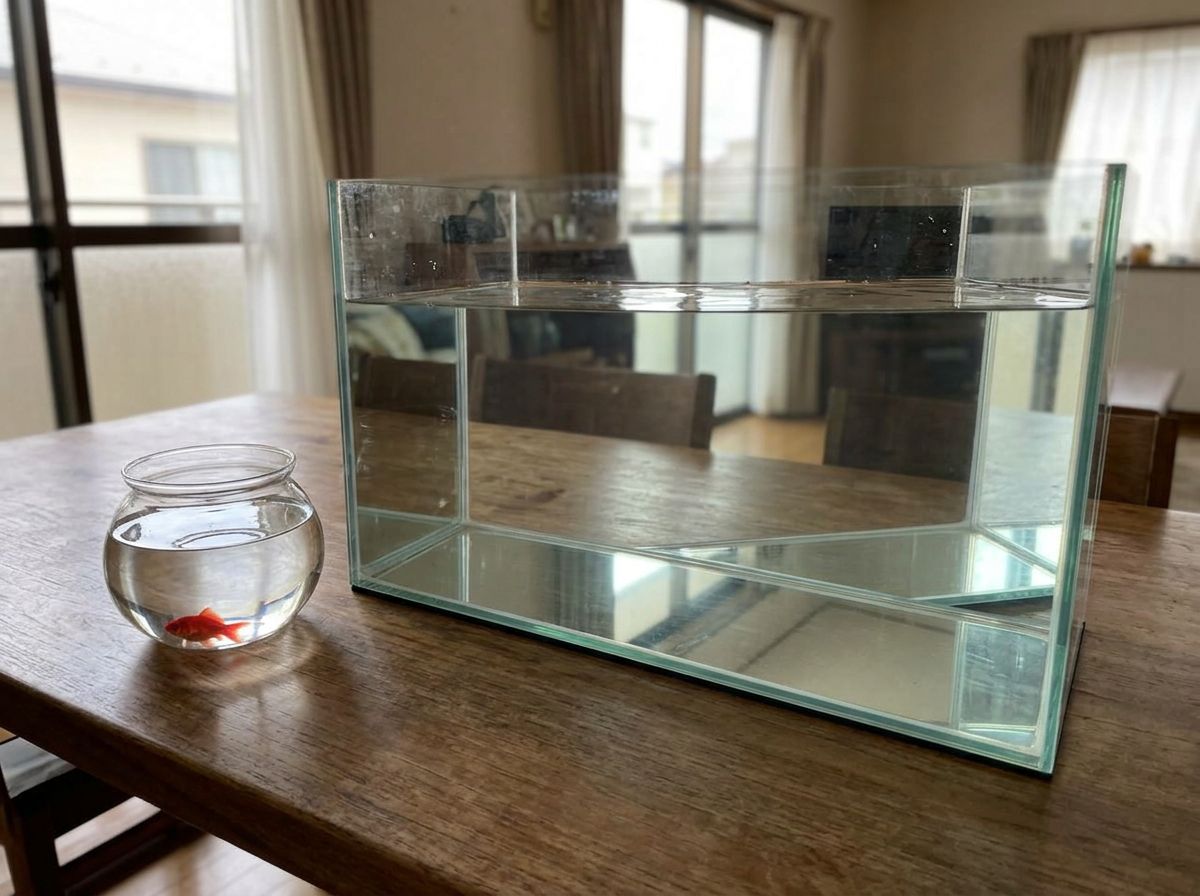
For the long term, a 60 cm (24 in) tank is the recommendation, and 45 cm (18 in) wide is the minimum. There are two reasons.
First, goldfish eat heavily and produce a lot of waste. More water means slower fouling and steadier temperature. Second, they grow. Shop fish are usually juveniles of 3-5 cm (1.2-2 in), but slim-bodied goldfish reach 15 cm (6 in) or more, and ryukin can reach 15-20 cm (6-8 in). Expect the container you bought them in to be cramped within a year.
A bowl or small tank can serve as a temporary home right after you bring a fish back. Even a large bowl is considered to hold one goldfish at most, and a container under 10 L (2.6 gal) is a guide for one or two fish of 3-4 cm (1.2-1.6 in). Treat these as stopgaps rather than a lifetime home.
Stocking: 2-3 L of water per centimeter of fish
If you plan to keep them to adulthood, the guidelines are:
- Work from 2-3 L per centimeter of body length (roughly 1.3-2 gal per inch): 20-30 L (5-8 gal) for one 10 cm (4 in) goldfish, 30-45 L (8-12 gal) at 15 cm (6 in)
- Even for small fish, treat 10 L (2.6 gal) per fish as the bare minimum, and use whichever of the two figures is larger
- The often-quoted "three or four fish in a 60 cm tank" (about 57 L / 15 gal) holds only up to about 10 cm (4 in) each; for adults in the 15 cm (6 in) class the same tank suits one or two
Next to the common tropical rule of one liter per centimeter of fish (about 0.7 gal per inch), goldfish need two to three times the water.
Some manufacturer charts say things like "8-12 fish in a 60 cm tank". Those numbers are for juveniles of 3-5 cm and are a different measure from the adult guideline, so don't mix the two. Start with one or two fish and stay on the light side; both the water and the fish stay steadier. The Aichi institute's advice is that the right number is one that feels "slightly too few".
Filtration, water changes and testing during setup
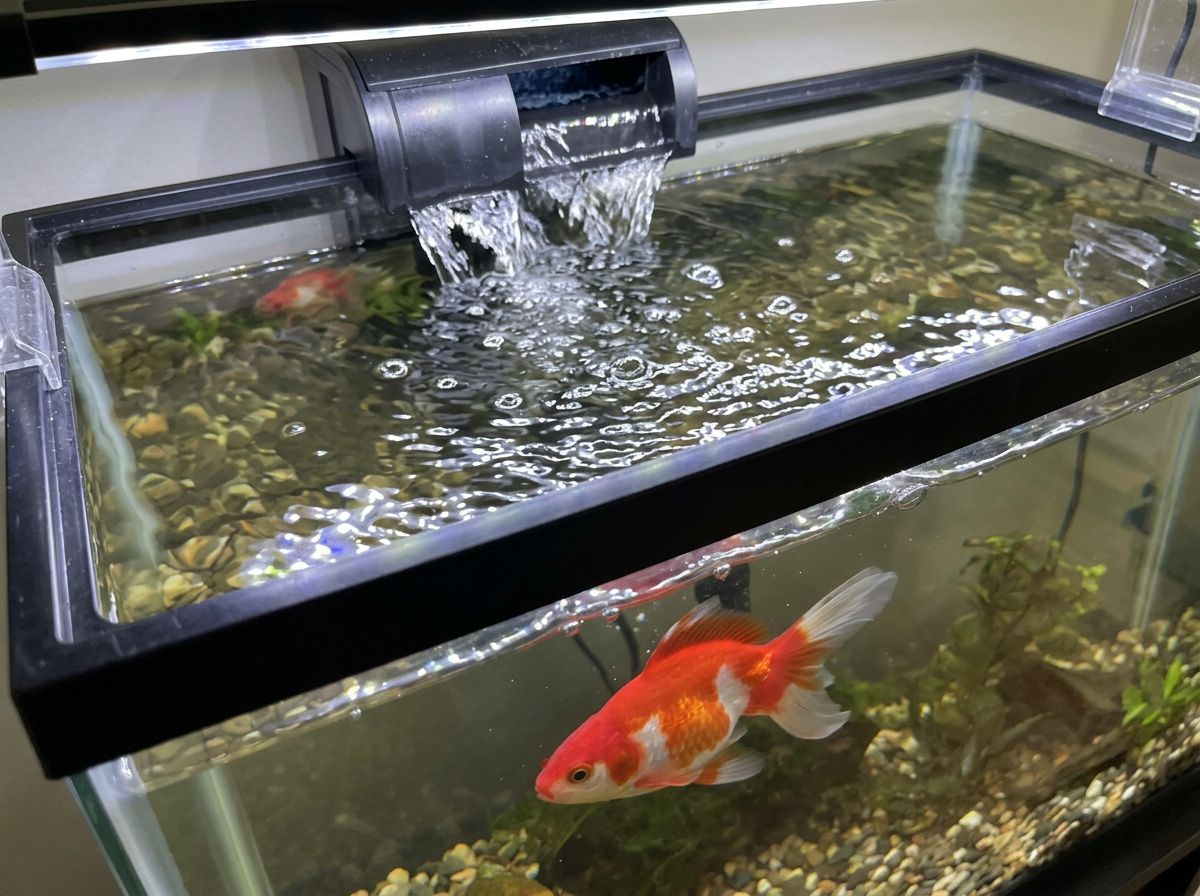
For a filter, a top-mounted trickle filter (common in Japan for its capacity) or a hang-on-back filter is the usual recommendation. Movement at the surface also brings in oxygen.
The baseline water change is one third every one to two weeks. Make it weekly if the tank is small, heavily stocked, home to large fish, or fed generously. Always dechlorinate new water and match its temperature: water more than 1°C (about 2°F) colder or more than 2°C (about 4°F) warmer than the tank is a strain on goldfish.
Watch out for the traditional bowl routine of "when it gets dirty, replace all the water and scrub everything". Don't change all the water, don't wash out the whole tank, and don't rinse filter media under the tap. Scrubbing the tank and tap-rinsing the media strip out, in one go, the filter bacteria that keep the water safe; a full water change shifts temperature and water chemistry all at once and is hard on the fish. Rinse media in water taken from the tank instead.
The setup period needs extra care. A new tank takes about a month for filter bacteria to settle in, and until then ammonia and nitrite from fish waste build up easily (see the nitrogen cycle explained).
- For the first two to three weeks after setup, change one third every two to three days
- Feed lightly for roughly the first month
- For the first six weeks, test ammonia and nitrite daily (every two to three days at the very least). The target for both is zero. While either shows a reading, bring the next water change forward
If you are setting up before buying fish, fishless cycling lets you grow the bacteria first.
Feed once or twice a day, only what they finish quickly
Feed once or twice a day, an amount they finish within a few minutes. Sources put "a few minutes" anywhere from one to five; when unsure, the shorter time (less food) is the safer choice.
Goldfish have no stomach and cannot digest a big meal well. Overfeeding leads to both digestive trouble and dirty water, so small portions suit them. Net out anything left uneaten.
FAQ
How long do goldfish live?
Sources vary, but five to ten years is not unusual and many goldfish live beyond ten. Generous water volume and clean water are the foundation.
Can I keep a goldfish in a bowl permanently?
It is safer to treat a bowl as temporary. Small volumes foul fast and swing in temperature. While a fish is in a container under 10 L (2.6 gal), change water much more often, from daily to three times a week, and move it to a tank of 45 cm (18 in) or more soon.
What if I can no longer keep them?
Never release them into a river or pond. Japan's Ministry of the Environment and the ornamental fish trade association warn that releasing ornamental aquatic life, goldfish included, harms the species already living there, and they ask keepers not to release fish and to care for them for life. If you truly cannot keep them, ask family or friends, or a shop that takes fish in.
Summary
- Most comfortable at around 20-25°C (68-77°F), within 15-28°C (59-82°F). Slim-bodied types overwinter unheated; fancy types are weaker in the cold
- 60 cm (24 in) tank recommended, 45 cm (18 in) minimum. Bowls and small tanks are temporary
- Stock at 2-3 L per cm of body length (30-45 L / 8-12 gal at 15 cm). "Three or four in a 60 cm tank" holds only up to about 10 cm (4 in) per fish; for adults it is one or two
- Change one third every one to two weeks. No full water changes, no scrubbing the whole tank, no tap-rinsing filter media
- Test ammonia and nitrite daily for the first six weeks
- Feed once or twice a day, a quickly finished portion. When in doubt, feed less
Because goldfish foul water fast, a record of temperature and water changes is how you spot a change early. Log temperature and water changes in the Aquarium app to keep up the setup-period testing and never lose track of the next change. The app's temperature rating uses a general tropical range (22-28°C / 72-82°F), so read your log against the goldfish guide instead (15-28°C / 59-82°F, most comfortable around 20-25°C / 68-77°F).