Corydoras Care Basics: Temperature, Substrate and Group Size
Cory catfish do best at 22-26°C (72-79°F) on smooth, fine sand in groups of five or six. Here is how to handle temperature, feeding and weekly care.
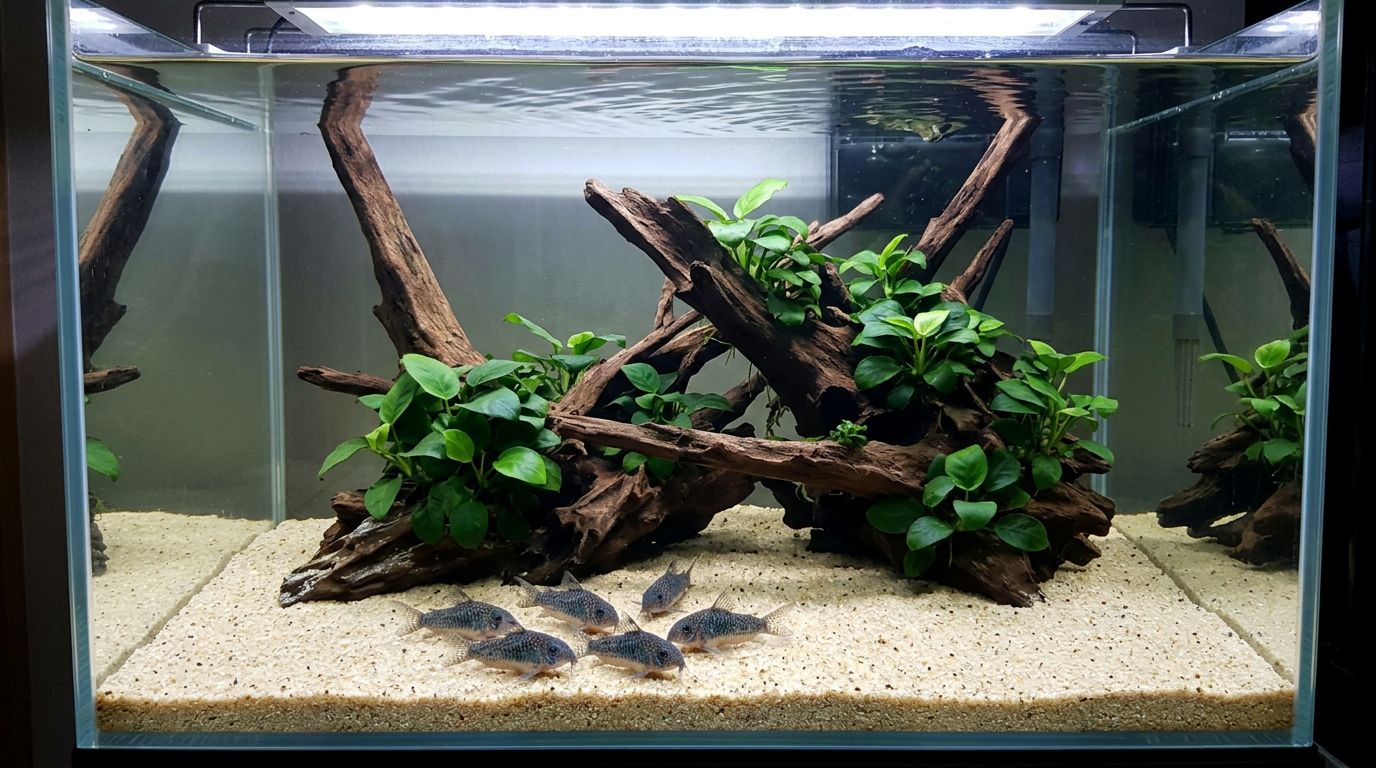
"A hardy little catfish that cleans up leftovers on the bottom." That is how corydoras are usually sold, and taking it at face value is how beginners get into trouble. The short version: corys are sensitive to warm water, sensitive to the type and cleanliness of the substrate, and need food of their own. Hardy does not mean you can be careless with them. It means they live a long time when the setup suits them, and fade quietly on the bottom when it doesn't. This guide covers temperature and pH, substrate, group size and tank size, feeding and water changes, with a focus on the common beginner species: bronze, albino, peppered, panda and Sterbai corys.
Aim for 22-26°C, and know that the upper limit depends on the species
For corydoras in general, the target is 22-26°C (72-79°F), centered around 25°C (77°F). That sits on the cool side of the usual tropical range of 22-28°C (72-82°F), and the important point is that corys are weak at the top end. In winter, use an aquarium heater.
On top of that, each species has its own comfortable range.
| Species | Target range | Tendency |
|---|---|---|
| Bronze cory, albino cory | 21-27°C (70-81°F) | Middle of the road, wide range |
| Peppered cory | 22-26°C (72-79°F) | Comfortable toward the cool end |
| Panda cory | 22-25°C (72-77°F) | The coolest of the beginner species; poor heat tolerance |
| Sterbai cory | 24-28°C (75-82°F) | Handles the warm end better |
In summer, think in steps rather than asking for one safe number. For bronze, albino, peppered and panda corys, start cooling once the water passes 26°C (79°F), and treat anything over 28°C (82°F) as heading into danger. Sterbai corys are the exception: they need attention once the water goes over 28°C. And 30°C (86°F) or higher is dangerous for every species. The species-by-species summer plan is in how warm is too warm for corydoras?.
For pH, aim for 6.0-7.5 (slightly acidic to neutral). Most tap water is fine, and avoiding sudden swings (0.3 or more in a day) matters more than the exact number.
Choose fine sand with no sharp edges
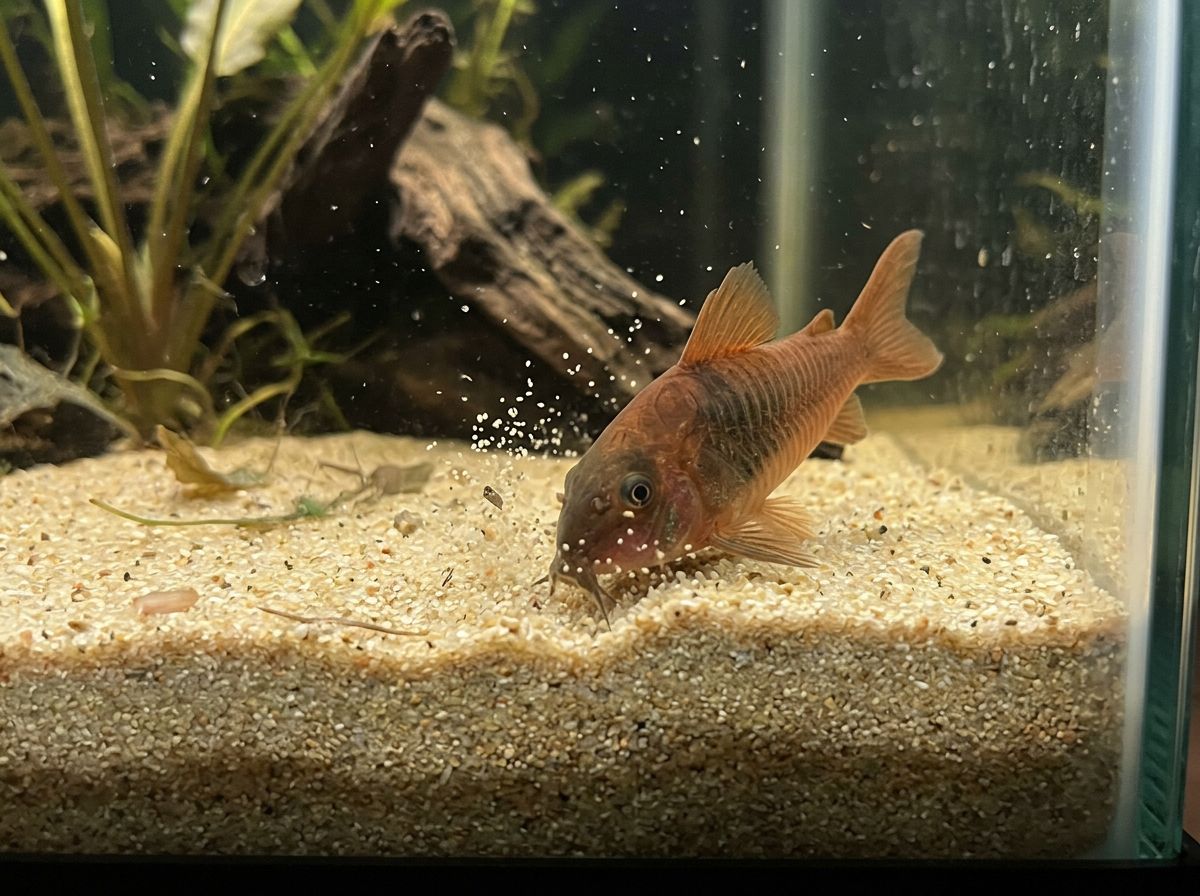
Corydoras find food by pushing their faces into the substrate. That is why the standard advice is fine, smooth-grained sand, such as river sand or the soft sands sold for bottom dwellers. Sharp-edged gravel can injure the mouth and barbels.
Among the substrates common in Japan, Oiso gravel is considered usable only in its fine grade; the medium grade is described as dangerous for corys. Planted-tank soil is a poor match, and coral sand should not be used. A bare-bottom tank is also an option.
Keep five or six or more, and a 60 cm tank is the safe choice
Corydoras are schooling fish. Kept as one or two, they tend to turn timid and stay hidden, so keep five or six or more of the same species, and no fewer than three.
A standard 60 cm (24 in) tank of about 57 L (15 gal) is the safe choice. A small group of three to five can live in a 30-45 cm (12-18 in) tank, but because corys live on the bottom, floor area matters as much as volume. They also eat well and foul the water quickly, so don't crowd a small tank. Some overseas care guides set a stricter bar, such as six or more fish and 70 L (18 gal) or more. To check what your own tank holds, see how to calculate tank volume.
Timing matters too. Don't add corys to a newly set-up tank. Wait until the nitrogen cycle is established (for several days running, ammonia and nitrite are back to 0 the day after you add an ammonia source), then add fish a few at a time. When you add fish to a tank that already holds fish, the standard recommendation is about two weeks of quarantine in a separate tank before they join the main one. If the corys are the first fish in a cycled but empty tank, no separate tank is needed, but watch them daily for the first two weeks and leave at least two weeks before adding anything else. To acclimate, float the bag for 15-30 minutes to match temperature; for panda corys, which are sensitive to changes in water quality and temperature, drip acclimation over 30-60 minutes is the gentler route.
One more practical note: some corydoras carry an irritant in the spines of their pectoral and dorsal fins. The spines can also catch in nets and puncture bags, so don't pick them up with bare hands.
Feed a sinking food made for them, once or twice a day
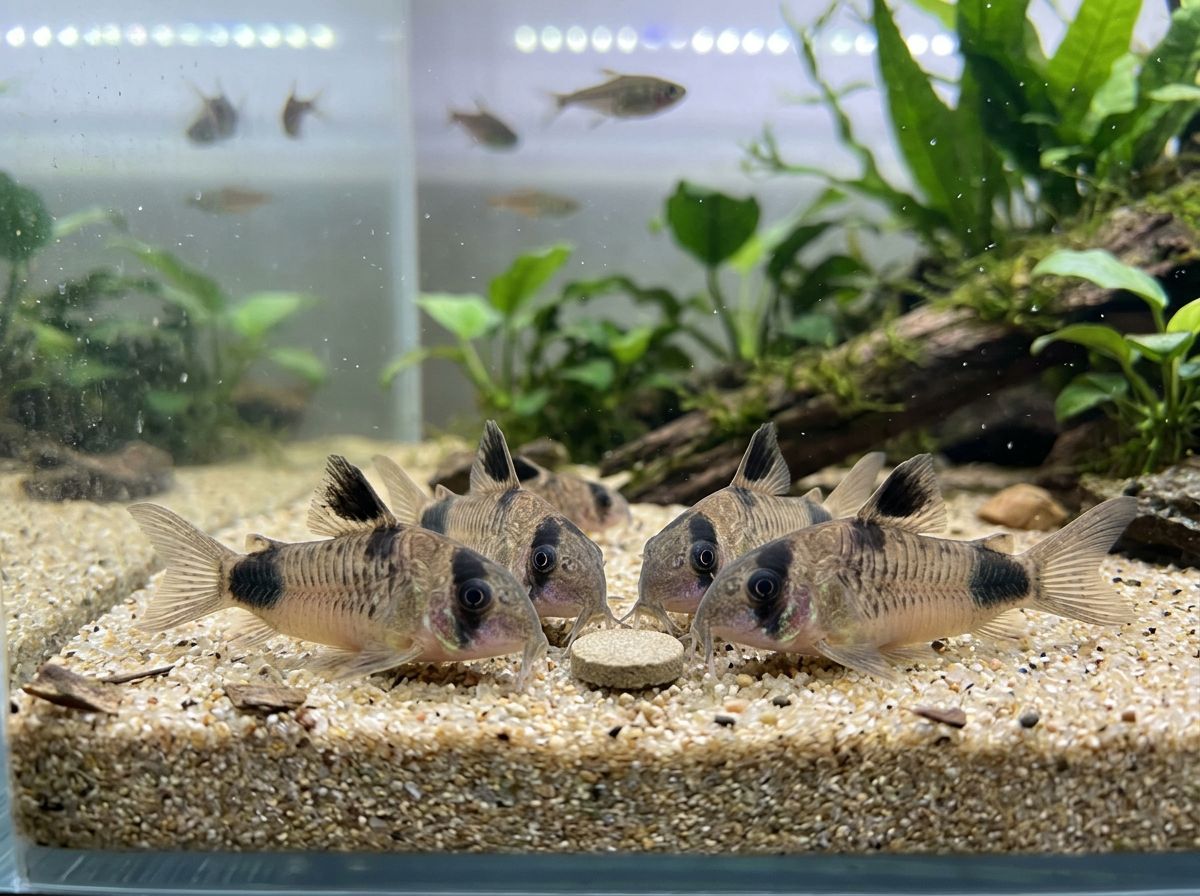
Corydoras are neither a cleanup crew nor algae eaters. Other fishes' leftovers are not enough, and they do not eat algae, so the starting point is a sinking food of their own as the staple.
Feed once or twice a day, about as much as they finish in three minutes. Frozen bloodworms and similar foods are a supplement. Flakes and granules tend to be eaten by fish higher in the water before they reach the bottom, so in a community tank, check that food is actually getting into the corys' mouths. For the general thinking on portions, see how much and how often to feed.
Change about a third of the water weekly, and clean the substrate with it
The guideline for water changes is once a week, about one third of the tank. Always dechlorinate the new water and match it to within 1-2°C (2-4°F) of the tank.
What matters especially in a cory tank is cleaning the substrate. When leftover food and waste build up in the sand, the fish that live with their mouths on it end up with damaged mouths and barbels. Roughly every one to two weeks, vacuum the dirt out of the substrate with a gravel cleaner while you change water.
FAQ
How long do corydoras live?
Around three to five years is the usual guide, and longer under good conditions. A temperature that fits the species, a clean substrate and food that actually reaches them are the foundation.
They swim up and gulp air. Are they struggling?
Corydoras can also breathe through the gut, and an occasional dash to the surface for air is normal in healthy fish. What to watch is the change: if trips become clearly more frequent than usual, or several fish go up one after another, suspect low oxygen or declining water quality.
Can I add medication or salt when one looks unwell?
Not on your own judgment. Catfish, corydoras included, are regarded as sensitive to medications, and it is safest to treat salt the same way. Move the unwell fish to a separate tank (dechlorinated water matched to within 1-2°C / 2-4°F of the main tank, and kept within the species' range), restore water quality in the main tank with a water change and a substrate clean, and ask a specialist shop for advice.
Summary
- Target 22-26°C (72-79°F). Pandas run cooler (22-25°C), Sterbai warmer (24-28°C), with bronze, albino and peppered corys in between
- Start cooling above 26°C; over 28°C is heading into danger (for Sterbai, over 28°C calls for attention). 30°C or higher is dangerous for all species
- Use fine sand with no sharp edges. Oiso gravel only in the fine grade; planted-tank soil is a poor match
- Keep five or six or more of the same species (minimum three); a 60 cm tank is the safe choice
- Feed a sinking food made for them once or twice a day. They are not a cleanup crew or algae eaters
- Change about a third of the water weekly; clean the substrate every one to two weeks
- No medication or salt on your own judgment. And if you can no longer keep them, never release them into a river or pond
Because each species has its own range, the useful question is how today's temperature looks for the corys in your tank. Log daily temperature in the Aquarium app and you can watch the graph creep toward the upper limit in summer, so you start cooling in time. The app judges temperature against the general tropical range (22-28°C / 72-82°F), so in a cory tank read your log against the range for the species you keep (22-25°C for pandas, for example).