10 Beginner Fish Compared: Temperature, Tank Size and Stocking at a Glance
Choosing a first fish? Compare 10 beginner species side by side: target temperature, heater or not, tank size, group or solo, and how fast they breed.
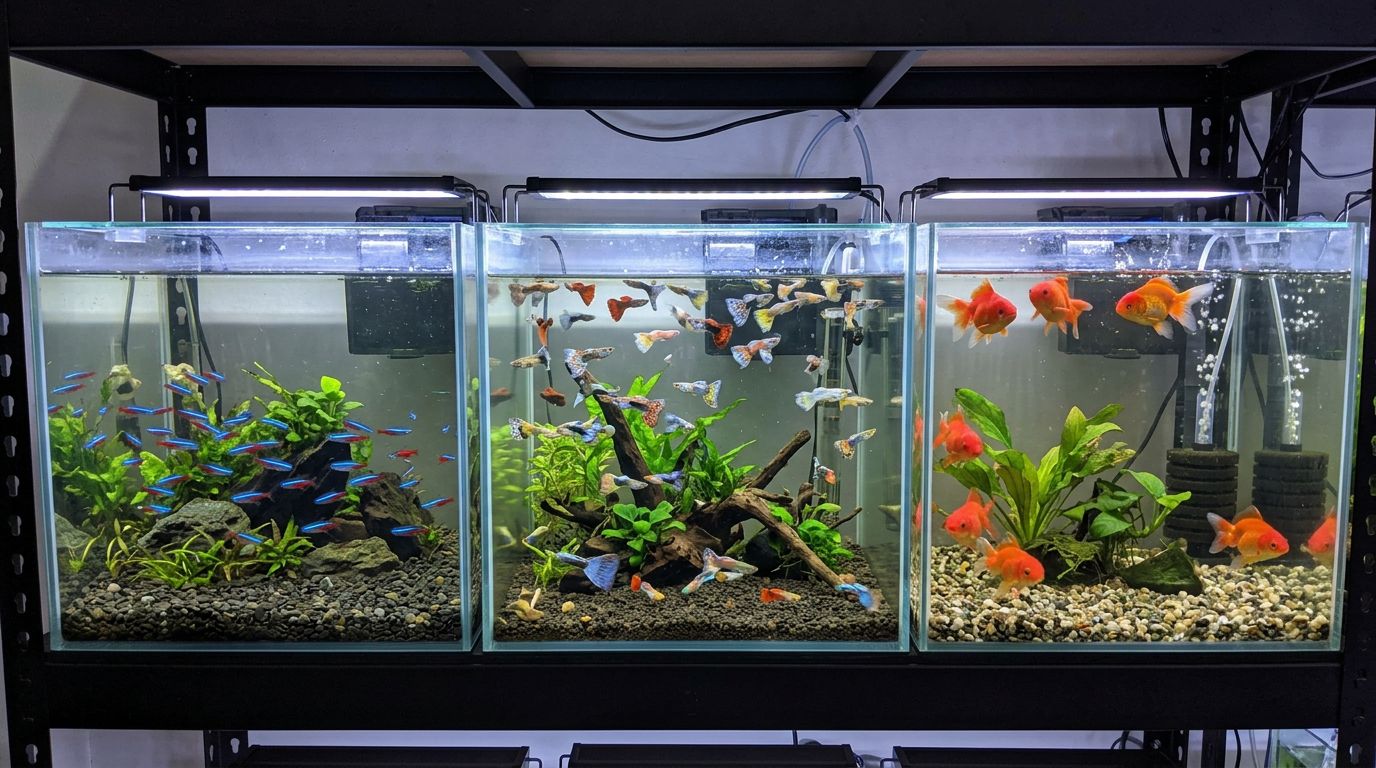
Plenty of species are sold as "beginner fish", and every one of them is described as hardy and easy. In practice they differ a great deal: in target temperature, in the tank they need, and in whether they live alone or in a group. The short answer is that popularity is a poor guide. Decide three things first: how big a tank you have room for, whether you will run a heater, and whether you are happy for the fish to breed. This article compares ten common starter species (nine fish and one shrimp) in a single table. It is not a ranking.
Three things to decide before you choose
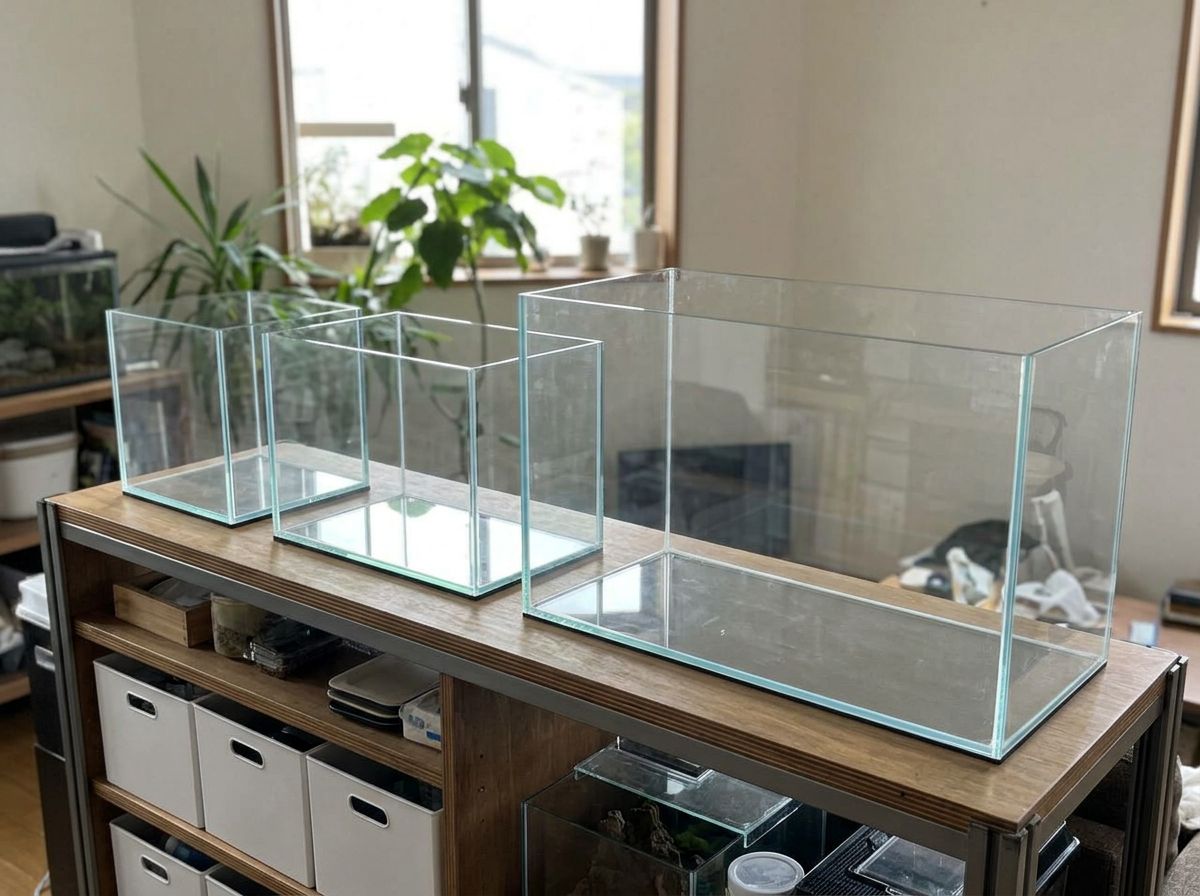
1. How big a tank you can fit
The larger the tank, the steadier its temperature and water quality. Only a few species suit a small tank, and some, goldfish for one, cannot be kept long term in a small one at all. Measure the space and settle on a tank size first.
2. Whether you will use a heater
The target for tropical fish is 22-28°C (72-82°F), and in winter that normally means a heater.
3. Whether you want them to breed
Guppies and platies give birth almost every month when males and females are together. Before you buy, think about whether you can keep the extra fish for life or have somewhere to rehome them. Whatever the species, never release surplus fish into a river or pond.
One more point applies to all of them: every species here does badly in a tank that has not finished cycling. Don't add fish on the day you buy the tank; cycle the tank first.
The ten species at a glance
Every figure here is a day-to-day target. Some species tolerate a wider range than this, but tolerance ranges are deliberately left out.
| Species | Target temperature | Heater | Tank guide | Stocking | Breeding and cautions |
|---|---|---|---|---|---|
| Medaka | 20-28°C (68-82°F) in the active season | Not needed (adults overwinter outdoors) | From a 5 L (1.3 gal) bowl to a 60 cm (24 in) tank; 10 L (2.6 gal) or more to overwinter outdoors | At most one fish per liter (a customary figure for planted outdoor containers); comfortably 2 L (0.5 gal) or more each | Breeds readily in the right conditions |
| Goldfish | Around 20-25°C (68-77°F) | Slim-bodied types: not needed. Fancy round-bodied types: safer heated | 60 cm (24 in) recommended, 45 cm (18 in) minimum | 2-3 L of water per cm of body length (about 1.3-2 gal per inch) | Grows large and fouls water quickly |
| White Cloud minnow | 18-25°C (64-77°F) | Not needed indoors as a rule (if the coldest reading stays at 15°C / 59°F or above) | From a 30 cm (12 in) tank | About 3 in a 30 cm tank; a group of 6 or more needs 45 cm (18 in) | Spawns on its own among dense plants |
| Betta | 25-28°C (77-82°F) | Essential | At least 10 L (2.6 gal), ideally 20 L (5 gal) or more | Alone (males can't share) | Kept singly, so numbers don't grow |
| Guppy | 23-26°C (73-79°F) | Essential | 30 cm (12 in) for a few; a 60 cm (24 in) class tank is advised for beginners | 3-6 L (0.8-1.6 gal) per adult; 2-3 females per male | 30-100 fry about every 30 days |
| Platy | Around 25°C (77°F) | Needed | Two fish at most in 30 cm (12 in); pairs and groups need 45-60 cm (18-24 in) | 3 or more, at least 2 females per male (in 45 cm or larger) | 20-50 fry about once a month |
| Neon tetra | 22-26°C (72-79°F) | Essential | 60 cm (24 in) for a proper school (a few will do in 30 cm) | In a school: at least 5-6, ideally 8-10 | Hard to breed at home |
| Corydoras | 22-26°C (72-79°F); panda 22-25°C (72-77°F), Sterba's 24-28°C (75-82°F) | Needed | 60 cm (24 in) is the safe choice (30-45 cm for a few) | In a group: 5-6 or more (3 at the very least) | May spawn on its own |
| Otocinclus | 21-26°C (70-79°F) | Needed | From a 30 cm (12 in) tank | One (two at most) in 30 cm; 2-3 (4 at most) in 60 cm or larger with plenty of algae | Suits a mature tank with algae |
| Neocaridina shrimp (cherry shrimp and relatives) | 22-25°C (72-77°F) | Depends on how cold the room gets | 30-45 cm (12-18 in) tank | Around 10 to start a breeding colony | Breeds readily; sensitive to sudden change |
Two things to note when reading the table.
- Target temperature differs between species, even among tropical fish. In a room that warms up in summer, the species with the lower ceiling (neon tetras, corydoras, otocinclus, Neocaridina shrimp) need more care
- The stocking column does not mean the same thing in every row. Some figures are ceilings (one fish per liter, two fish at most) and some are group minimums (at least 5-6). Start below a ceiling and add more while watching the water; start at the minimum for a schooling fish
To start without a heater: medaka, goldfish, White Clouds
The classic unheated choices are medaka (Japanese rice fish), slim-bodied goldfish and White Cloud Mountain minnows. The conditions differ for each, as the table shows, and this is not a suggestion to keep them in the same tank. Even unheated, check the thermometer every day. See keeping medaka, goldfish care basics and White Cloud Mountain minnow care.
For one fish in a small tank: the betta
If the plan is one small tank on a desk, the betta is the candidate. Bettas are kept alone as a rule, and males cannot share a tank. Contrary to the "lives in a jar" image, though, they need a tank of at least 10 L (2.6 gal) rather than a jar, plus a heater and a lid, because the less water there is, the faster temperature and water quality change. See betta care basics.
For a school, or for fish that breed
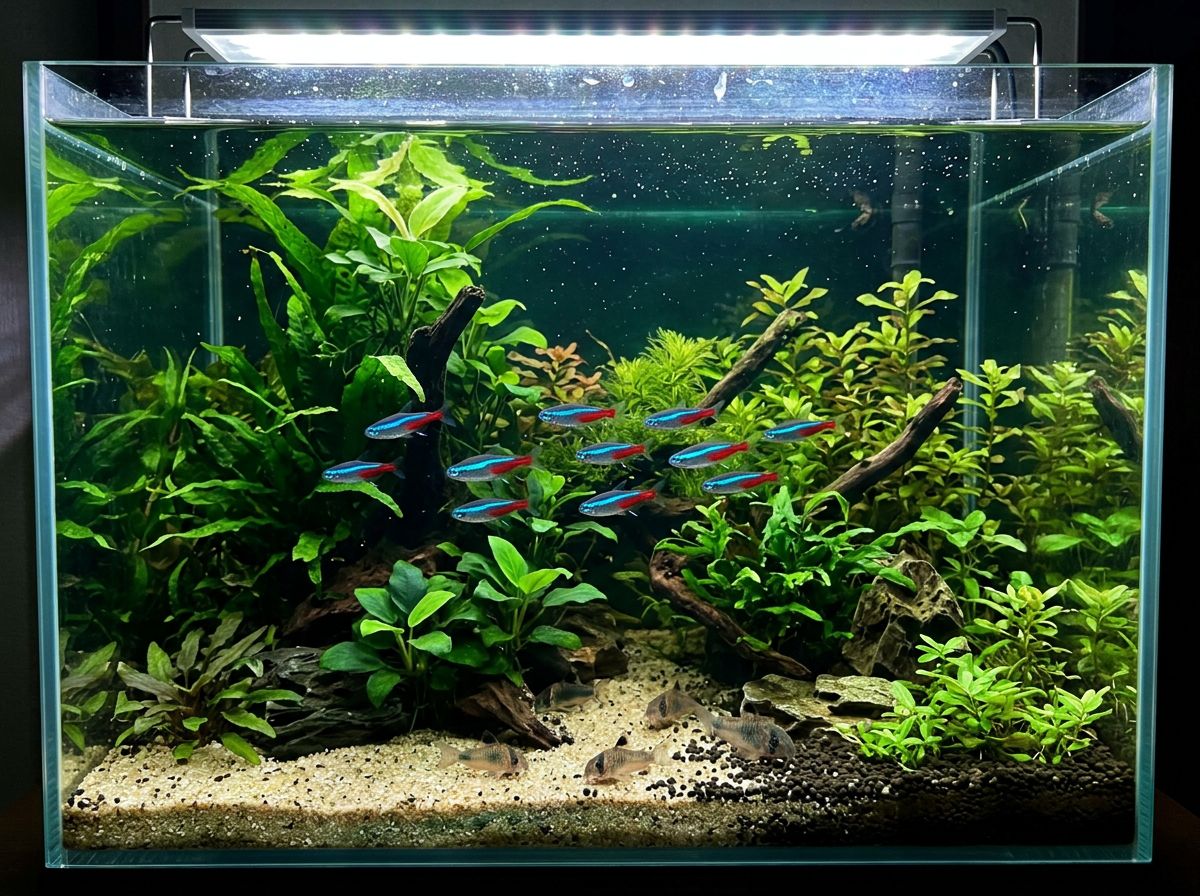
For a school on the move, look at neon tetras. They are called a starter fish, but they do poorly in a tank that is still cycling and when acclimation is skipped. See neon tetra care basics.
For something that works the bottom, there are corydoras. They need fine, smooth-grained sand and sinking food made for them that actually reaches the bottom. They are not a clean-up crew that can live on leftovers. See corydoras care basics.
If you would enjoy seeing fry, guppies and platies are the ones. Their water guide is neutral to slightly alkaline (pH 7.0-8.0), which leans a little differently from neon tetras and corydoras, which prefer slightly acidic to neutral. Above all, assume they will multiply, and decide on tank size and an exit plan first: someone to give fish to, or separating males from females. See guppy care basics and platy care basics.
Not for your very first addition: otocinclus and shrimp
Otocinclus and Neocaridina shrimp (cherry shrimp and their relatives) are popular algae eaters, and it is tempting to add them first as a cleaning crew. But both are animals to bring in once the tank has settled.
- Otocinclus: suited to a mature tank with plenty of algae and biofilm. Starvation once the algae runs out, and a tendency to decline soon after arrival, are regarded as the main risks. See otocinclus care
- Neocaridina shrimp: sensitive to sudden changes in temperature and water quality, and very sensitive to ammonia and nitrite. Confirm by testing that the cycle is complete, and introduce them with slow drip acclimation. See cherry shrimp and Neocaridina care basics
The order we suggest is to start with a small number of fish, then add animals like these once the tank is stable. Whenever you add new livestock to a tank that already has fish, keep the newcomers in a separate, already cycled container for about two weeks first.
FAQ
So which fish is the hardiest?
There is no single answer. Every species here does badly in a tank that is still cycling, or when temperature and water quality change suddenly. Choosing a species that fits the tank and the care you can actually provide does more for long-term success than choosing "the hardy one".
Can I keep several of these species together?
It depends on the combination. The basic rule is to pick tank mates whose temperature and water guides overlap and whose swimming level and size are compatible. Bettas, for example, are safest alone, and goldfish are best kept only with goldfish. Medaka and White Clouds work together only in an indoor tank kept where their target temperatures overlap, not in an outdoor medaka tub. When planning a community, check the conditions in each species' tank-mate article.
How many should I start with?
Where the figure is a ceiling (one fish per liter, so many liters per cm of body length), start below it. For schooling fish, start at the minimum that makes a viable group. With neon tetras, for example, begin with 6-10, then test nitrate every week for two to three weeks after adding fish, and add the next batch only if it has stayed under 40 mg/L. After the first fish go into a cycled tank, watch them every day for two weeks.
Summary
- Before choosing, decide how big a tank you can fit, whether you will use a heater, and whether you want the fish to breed
- Compare conditions in the table. The stocking column mixes ceilings and group minimums, so check which one you are reading
- Bring in otocinclus and Neocaridina shrimp once the tank has settled
- Every species does badly in a tank that is still cycling. Start light, and never release fish
Once you have chosen, learn that species' target temperature. Log daily temperature and water quality in the Aquarium app and the changes show up on a graph. The app judges against the general tropical range (22-28°C / 72-82°F for temperature), so for species that are fine cooler (medaka, goldfish, White Clouds), species with a lower ceiling (neon tetras, corydoras, otocinclus, Neocaridina shrimp) and bettas, with their higher lower limit, read your log against the targets in this table.